Behind the scenes7 min read
Getting recommended by ChatGPT: what a Swiss SME should publish
ChatGPT, Perplexity and Gemini cite businesses whose websites answer clearly. What an SME in French-speaking Switzerland should publish to be recommended.
 By Diego Penaloza Lopez ·
Contents
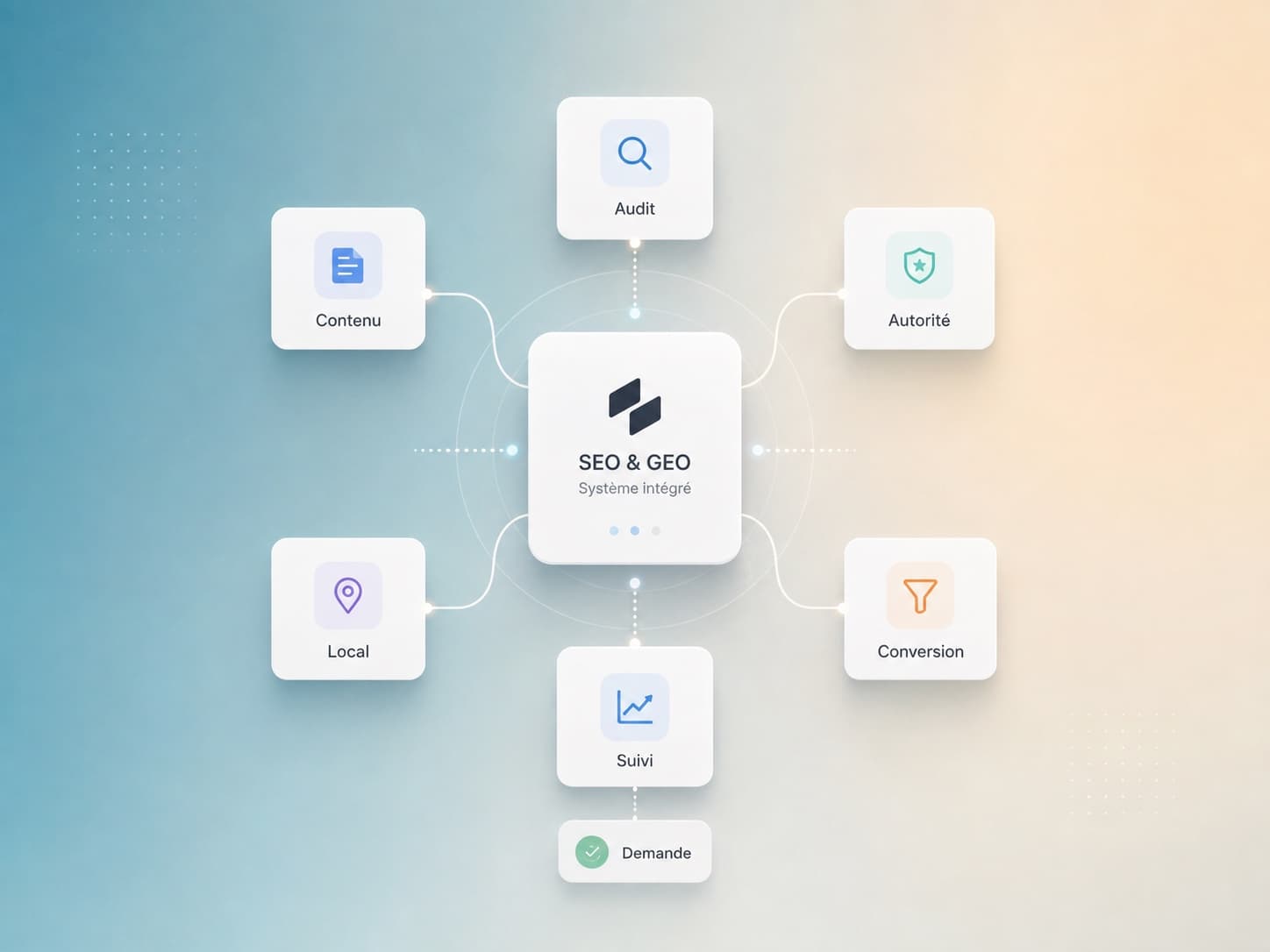
A business owner looking for an accountant, an installer or an agency no longer just types three words into Google. They ask an assistant a full question: “Which agency can help me sell a development of twelve apartments in the canton of Fribourg?” The assistant does not return ten links. It gives two or three names, with a sentence for each. The question becomes: how do you become one of those names?
How ChatGPT chooses which businesses to cite
When ChatGPT, Perplexity, Gemini or Google's AI Mode answer with a web search, they read a small number of pages, extract passages and compose an answer. A business gets cited if one of its passages answers the question better than the others, and if other sources confirm what it says about itself.
Two consequences. The page must contain the answer in a form that can be quoted: a sentence that stands on its own, without context. And the business must be recognisable: same name, same activity, same area, everywhere.
The five questions your website must answer
Assistants receive, in a thousand forms, the same questions your prospects ask on the first call. If your website does not answer them, the assistant will take the answer from elsewhere, often from a competitor.
- Who are you? One sentence with the name, activity, area and founding date or founder. For example: “Contrast is a marketing agency founded by Diego Penaloza Lopez, based in the canton of Neuchâtel.”
- Who do you work for? Type of business, size, sector. “For everyone” cannot be quoted.
- What exactly do you do? One page per service, with its scope, process and deliverables.
- How is the price built? Explain what drives the price and how the budget is split. A page that explains it will be cited instead of pages that avoid the subject.
- What have you achieved, and for whom? Named case studies, with figures the client has authorised.
Writing passages an assistant can quote
An assistant does not quote a slogan. It quotes a precise, verifiable statement placed right under the question it addresses. On our articles, each page opens with a two- or three-sentence summary: that is the passage designed to be reused as is. Subheadings are phrased like customers' questions, and each answer starts with the answer, not with the context.
Scroll the table horizontally ↔
| Hard to quote | Easy to quote |
|---|---|
| Innovative solutions to boost your visibility. | We run Google Ads and Meta Ads campaigns for SMEs in French-speaking Switzerland. |
| Tailored support adapted to your needs. | The first contact is a free 30-minute diagnostic, at our offices or by video call. |
| Exceptional results for our clients. | For Masini Groupe, qualified enquiries were multiplied by ten in twelve months. |
Making the business recognisable
An assistant cross-checks. If your website says “Dupont Renovation”, your Google profile “Dupont SA” and LinkedIn an old name, it hesitates, and a hesitant source does not get cited. Fix a reference wording (name, legal form, activity, area, contact) and repeat it word for word on the website, the Google Business Profile, LinkedIn, professional directories and the commercial register.
On the website, this information is also declared as structured data: an Organization node with the official profiles, a Person node for the founder, a signed Article for each publication. This markup does not replace the visible text; it confirms it.
Letting AI crawlers in
Check that your robots.txt file does not block GPTBot, OAI-SearchBot, ChatGPT-User, ClaudeBot, PerplexityBot or Google-Extended. Some themes and firewalls block them by default, and a page an assistant cannot read will never be cited. The content must also be in the delivered HTML: text that only appears after JavaScript runs is often ignored.
An /llms.txt file, which summarises the business and lists its main pages, guarantees nothing: no engine has committed to reading it. It takes an hour and gives the tools that do read it a clean entry point. We publish ours, as well as a full version, /llms-full.txt.
Measuring enquiries that come from ChatGPT
A visit from ChatGPT arrives with a chatgpt.com referrer or a utm_source=chatgpt.com parameter; Perplexity, Gemini and Copilot leave a similar trace. Record this source on arrival and attach it to every contact request. Without it, enquiries from assistants disappear into “direct” traffic and nobody knows whether the work pays off.
A second, simpler measure: ask every new client how they found you, and record the answer in the CRM. “ChatGPT gave me your name” is an answer heard more and more often, provided you ask the question.
What does not work
- Hidden pages or text written for robots. Text visitors cannot see is a source engines learn to ignore.
- Lists of towns. Repeating “agency in Lausanne, Geneva, Sion…” creates no local presence; one page per area with real information does.
- Unverifiable figures. “300% growth” with no client, no period and no source weakens the whole page.
- Generic articles. A text that could appear on any website adds nothing an assistant does not already know.
Key takeaways
- 01ChatGPT cites passages that answer a question on their own, placed under a clear heading.
- 02Your website must say who you are, for whom, what, how pricing works and with which results.
- 03Business information must be identical everywhere you appear.
- 04AI crawlers must be able to read your pages, with no blocking or hidden content.
- 05Enquiries from assistants are measured through the visit source and the question “how did you find us?”.
FAQ
Frequently asked questions
No. Assistants largely rely on the same signals: indexable pages, clear content, links, a consistent business identity. GEO adds a writing requirement (quotable answers) and a measurement requirement (recording visits from assistants).
ChatGPT's organic answers cannot be bought. Some assistants are testing separate advertising formats, labelled as such. Being cited in the answer itself depends on the content published and the reputation of the business.
There is no guaranteed timeframe. Assistants that search the web can cite a page as soon as it is indexed; the knowledge built into the models changes more slowly, as they are updated.
Ask it your customers' questions, with web search enabled: “which company for… in Neuchâtel?”, “is [your name] any good?”. Note the names cited and the pages given as sources. Repeat each month with the same questions.
Share
